End-to-End AI Risk Platform Architecture
A reference blueprint for building a unified AI-native risk platform for modern banking and finance.
Article Focus
- Written for: CRO teams, model risk teams, enterprise architects, risk engineering leaders, and platform owners
- Core objective: connect data, modeling, controls, and decisioning into one governed operating system
Why Most Risk Stacks Fail at Scale
Many organisations have individual risk engines, separate data marts, and disconnected model pipelines. This usually creates:
- Inconsistent definitions across credit, market, liquidity, and operational risk
- Slow model conceptual deployment cycles due to fragmented handoffs
- Limited traceability from business decision back to model inputs and control evidence
- Duplication of infrastructure and governance controls across teams
The end-to-end platform model solves this by standardising data contracts, orchestration, governance, and serving paths across all risk domains.
Reference Architecture
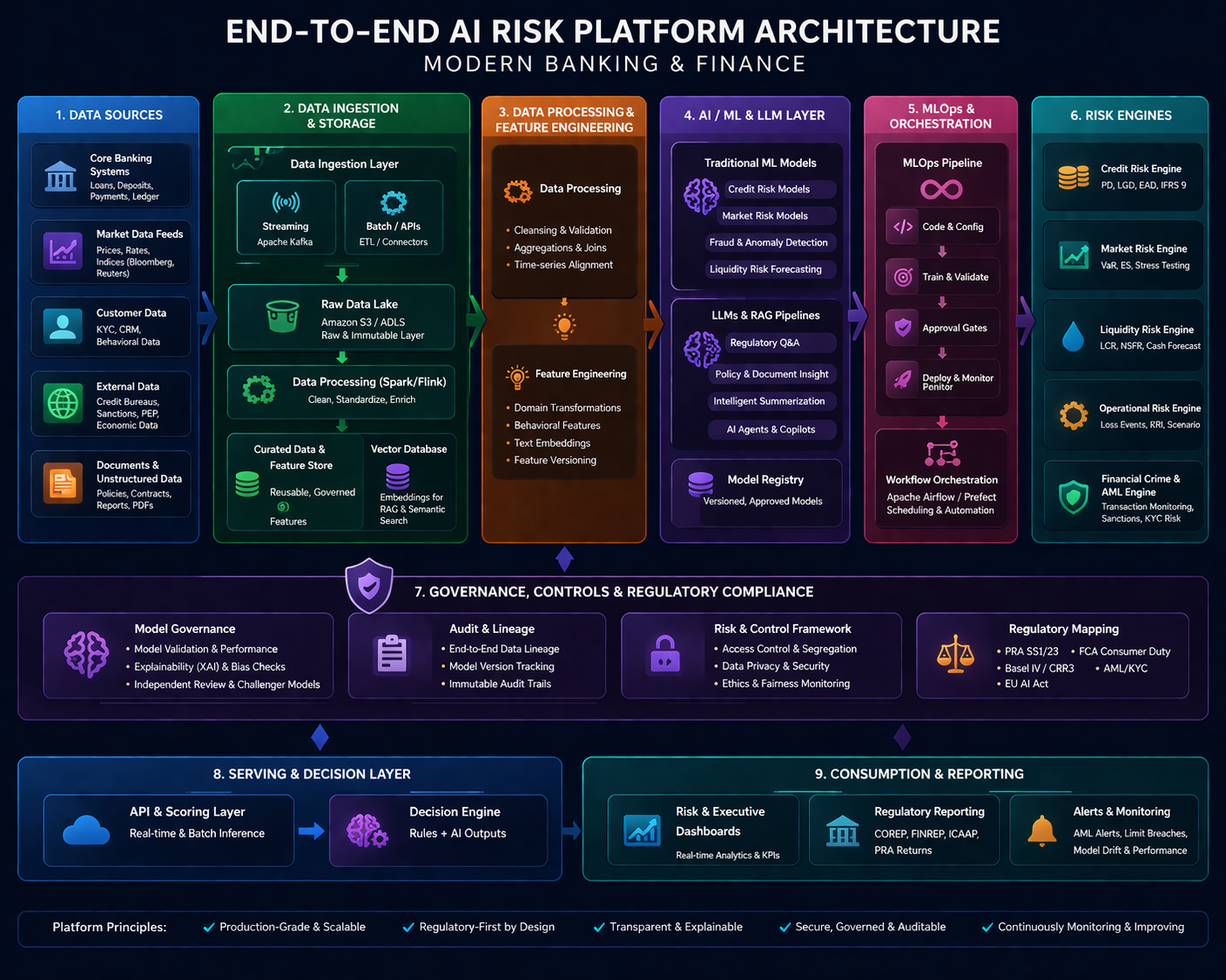
Platform Layer Overview
flowchart TD
  A["Data Sources\nTransactions · Market · KYC · External · Unstructured"]
  B["Ingestion & Storage\nEvent Stream · Batch · Data Lake · Feature Store · Vector Layer"]
  C["Feature Engineering\nCleansing · Temporal Alignment · Domain Features · Versioning"]
  D["AI / ML / LLM Layer\nRisk Models · RAG Pipelines · LLM Reasoning · Model Registry"]
  E["MLOps & Orchestration\nTrain → Validate → Deploy · Monitoring · Approval Gates"]
  F["Risk Engines\nCredit · Market · Liquidity · Operational · Financial Crime"]
  G["Governance & Control Plane\nModel Governance · Lineage · Privacy · Regulatory Mapping"]
  H["Serving & Decision Layer\nReal-Time APIs · Decision Engine · Human Override Workflows"]
  I["Consumption\nExecutive Dashboards · Regulatory Packs · Alerting"]
  A --> B --> C --> D --> E --> F --> G --> H --> I
  style A fill:#1D4C8F,stroke:#2F80ED,color:#E6ECF7
  style I fill:#1D4C8F,stroke:#2F80ED,color:#E6ECF7
Architecture Breakdown (Layer by Layer)
1. Data Sources
- Core banking transactions: loans, deposits, repayments, payments
- Market feeds: rates, FX, spreads, equities, volatility signals
- Customer intelligence: KYC, behaviour, CRM, interaction history
- External intelligence: bureaus, sanctions, macroeconomic indicators, regulator publications
- Unstructured evidence: policies, legal agreements, credit memos, audit documentation
2. Data Ingestion and Storage
- Event-stream ingestion for low-latency risk signals
- Batch/API ingestion for scheduled and partner feeds
- Raw immutable data lake as legal-grade source of truth
- Curated data products and governed feature store for model reuse
- Vector data layer for policy retrieval and semantic compliance support
3. Data Processing and Feature Engineering
- Cleansing, validation, and conformance checks
- Temporal alignment for cross-source event consistency
- Domain feature generation (PD/LGD/EAD, VaR factors, liquidity stress factors)
- Feature versioning for reproducible model training and audits
4. AI / ML / LLM Layer
- Traditional risk models for scoring, detection, and forecasting
- LLM and RAG pipelines for policy reasoning, document insight, and controls copilots
- Model registry for approved versions and controlled promotion
5. MLOps and Orchestration
- Train/validate/deploy lifecycle with approval gates
- Workflow orchestration for scheduled and event-driven jobs
- Monitoring for drift, performance decay, and policy guardrail breaches
Model Lifecycle and MLOps Loop

6. Risk Engines
flowchart LR
  FE["Feature Store\n+ Vector Layer"] --> CR["Credit Risk\nPD · LGD · EAD · IFRS9"]
  FE --> MR["Market Risk\nVaR · ES · Stress Scenarios"]
  FE --> LR["Liquidity Risk\nLCR · NSFR · Cash Forecast"]
  FE --> OR["Operational & Crime\nFraud · AML · Scenario Loss"]
  CR --> DS["Decision\nServing Layer"]
  MR --> DS
  LR --> DS
  OR --> DS
- Credit risk engine (PD, LGD, EAD, IFRS 9-style outputs)
- Market risk engine (VaR, expected shortfall, stress scenarios)
- Liquidity risk engine (LCR, NSFR, cash forecasting)
- Operational and financial crime engines (fraud, AML, scenario loss analysis)
7. Governance and Regulatory Control Plane
- Model governance and independent challenge workflows
- End-to-end lineage and immutable audit trails
- Data privacy, access segregation, and control attestations
- Regulatory mapping to PRA, Basel, CRR/CRD, AML, and AI governance frameworks
Governance and Decisioning Flow

8. Serving and Decision Layer
- Real-time and batch scoring APIs
- Decision engine combining risk outputs with policy rules
- Human override workflows with reason logging
9. Consumption and Reporting
- Executive and board dashboards
- Regulatory reporting packs
- Alerting for threshold breaches, drift, and control failures
End-to-End Platform Flow

What Makes This Architecture Enterprise-Grade
- Unified feature and data contracts across risk domains
- Shared governance plane instead of duplicated controls per team
- Clear separation between model execution and policy decisioning
- Traceability from board metric back to source records and model version
- Continuous monitoring tied to operating thresholds and remediation playbooks
Vendor-Neutral Implementation Rule
Design the platform around capabilities, not products. For each layer, define:
- Functional requirement (what the layer must do)
- Non-functional requirement (latency, resilience, security, auditability)
- Interoperability contract (schemas, APIs, event formats, lineage fields)
This allows teams to swap tools over time without redesigning the operating model.
Implementation Blueprint (90-Day Path)
sequenceDiagram
  participant P as Platform Team
  participant R as Risk SMEs
  participant G as Governance
  participant B as Business
  Note over P,B: Phase 1 — Foundation (Weeks 1–4)
  P->>R: Define domain scope and data contracts
  R-->>P: Canonical schemas and lineage baseline
  P->>G: Stand up ingestion pathways and lake zones
  Note over P,B: Phase 2 — Risk Intelligence (Weeks 5–8)
  P->>R: Build feature store + vector policy layer
  R-->>P: Deploy risk models and decision APIs
  P->>G: Integrate model lifecycle controls
  Note over P,B: Phase 3 — Governance & Scale (Weeks 9–12)
  P->>B: Dashboard, alerting, and regulatory packs
  P->>G: Model monitoring and retraining triggers
  P->>R: Expand to additional risk engines
KPI Framework to Track Value
| KPI Category | Metric | Target |
|---|---|---|
| Platform | Model conceptual deployment cycle time | < 5 business days |
| Platform | Decision lineage coverage | > 98% |
| Platform | Feature reuse rate across teams | > 60% |
| Risk Outcomes | Early-warning lead time improvement | +48h average |
| Risk Outcomes | Drift detection to remediation | < 24h |
| Compliance | Audit evidence completeness | > 99% |
| Compliance | Regulatory reporting cycle time | -40% reduction |
Common Pitfalls and How to Avoid Them
| Pitfall | Risk | Mitigation |
|---|---|---|
| Separate stacks per risk type | Fragmented governance, duplicated cost | Enforce shared platform standards early |
| Governance as post-processing | Control gaps that fail audit | Embed controls in every layer |
| Policy logic inside model code | Hard to update, impossible to audit | Externalise and version policy rules |
| Skipping operational readiness | No-one knows who responds to alerts | Define alert ownership and runbooks before launch |
Final Thought
An end-to-end AI risk platform is not just a technology upgrade. It is an operating model shift that aligns risk analytics, AI delivery, governance, and executive decisioning on one production-aware foundation.